

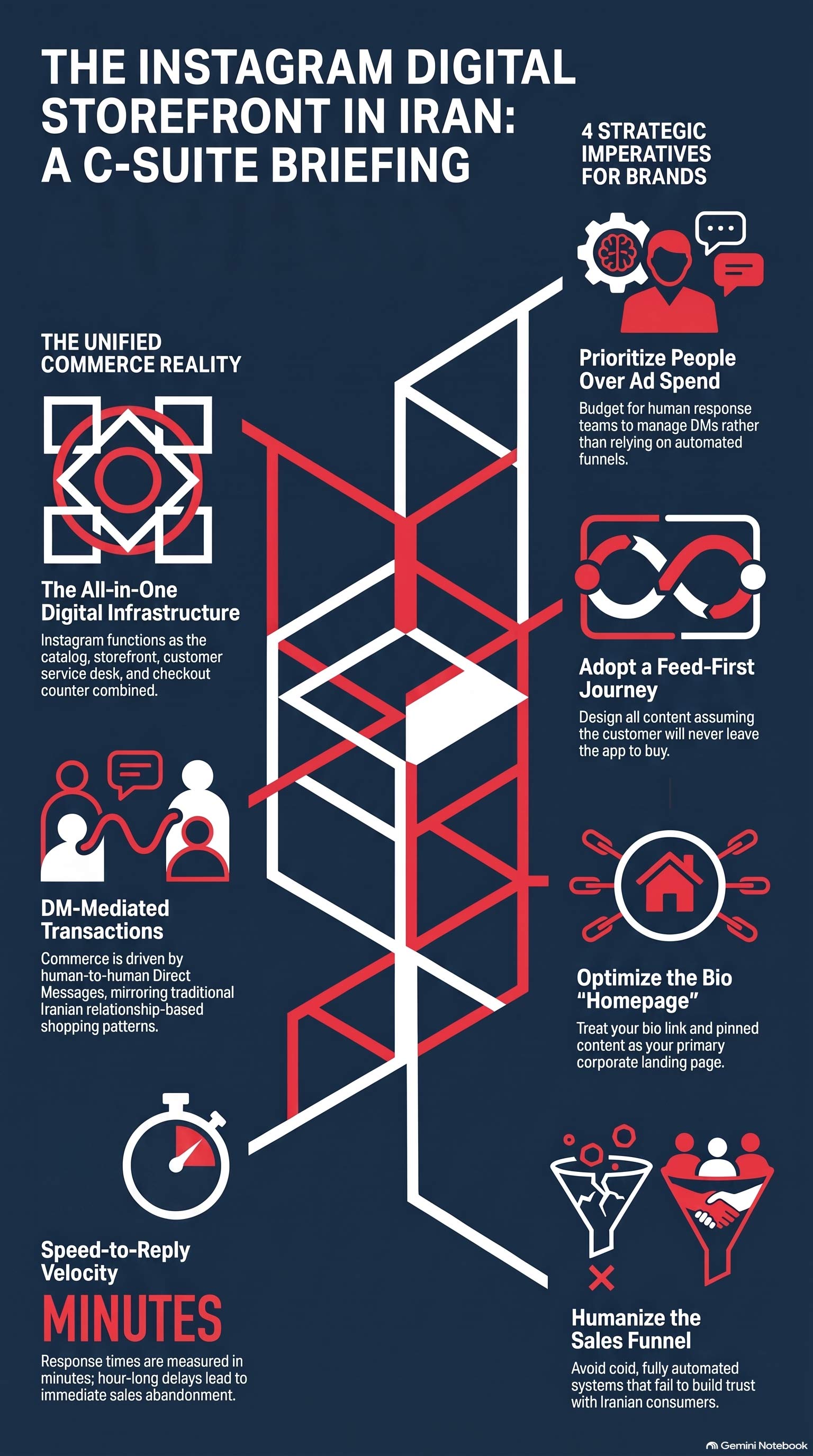
In most markets, a brand's Instagram page is one channel among many — a place for visual storytelling that sits alongside a fully functional e-commerce site, a Google-indexed presence, and a handful of other ad platforms. In Iran, for a large share of small and mid-sized businesses, Instagram has often functioned closer to the entire digital storefront: catalog, storefront, customer service desk, and checkout counter rolled into one profile. If you're building a marketing plan around Instagram being "just" a social channel here, you're underestimating what it actually has to do.
In short:
- In Iran, for a large share of small and mid-sized businesses, Instagram isn't just a social network; it's catalog, storefront, support desk and checkout in one profile.
- "Buying on Instagram" often happens through direct messages with a real person on the other end, not an automated funnel.
- For a foreign brand: invest in people, not just ads, and treat your profile as your real homepage.
- Platform access is fluid; any entry plan should start with a current check of platform access and behavior.
How this happened
Several major global social platforms have, at various points, been restricted or filtered for users inside Iran, while Instagram has often remained more accessible or been treated differently by users working around restrictions. That single difference compounded over years: as businesses and consumers concentrated onto one platform instead of spreading across many, Instagram absorbed roles that Facebook Marketplace, Twitter, and dedicated e-commerce sites split up in other markets. This status is fluid and can change — which is exactly why any current go-to-market plan needs a real-time check on platform access and behavior, not an assumption based on what was true a year or two ago.
What "shopping on Instagram" actually looks like
For a foreign marketer used to native Instagram Shopping tags, checkout, and Meta's ad-to-purchase tracking, the operational reality here can look surprisingly manual: a product photo, a price in the caption or bio link, and a purchase completed through direct messages — often with a human on the other end negotiating, confirming availability, and arranging payment and delivery individually. It's inefficient by Western automation standards, but it works because it mirrors how Iranian consumers have shopped from small, independent sellers for years. A brand that ignores this and insists on a fully automated, self-serve funnel will look colder and less trustworthy than a local competitor who replies personally within minutes.
A typical purchase journey on Iranian Instagram (from the customer's side)
- Discovery: The customer sees the product in a feed, Explore, or a page's stories.
- Credibility check: They look at the profile, the number and quality of comments, previous posts, and sometimes customers' highlights.
- Questions in DMs: Price, availability, color/size, delivery time.
- Payment and delivery coordination: Usually with a real person, sometimes with a receipt sent or a phone follow-up.
- After purchase: The page's trust score is built or broken by after-sale behavior — again visible through DMs and comments.
Each of these steps is a potential drop-off point that a foreign brand needs a plan for.
What this means for your brand
- Budget for people, not just ad spend. A page that gets attention but takes hours to answer a DM will lose the sale to a smaller competitor who answers in minutes.
- Design your content for a feed-first, not a website-first, buyer journey. Assume a meaningful share of your prospective customers will never leave the app before deciding to buy.
- Treat your bio link and pinned content as your actual homepage. It often gets more attention than your real website will for the first stretch of your presence here.
- Don't assume standard Meta ad tooling behaves identically here. Delivery, targeting precision, and payment for ad spend can all work differently than in markets with full platform access — budget time to test before you budget money to scale.
Common mistakes foreign brands make on Iranian Instagram
- Relying on automated replies and bots instead of fast human responses.
- Translating global content word for word, ignoring local tone and language.
- Having no clear point of contact to confirm availability, price and delivery time.
- Designing the sales funnel around a website when customers have no intention of leaving the app.
- Measuring performance by followers and likes instead of DMs that lead to purchases.
The bigger lesson
Instagram's dominance here is really a symptom of a broader pattern: Iran's digital landscape didn't evolve in parallel with the rest of the world's platforms, it evolved around the gaps left by restricted access. That same logic applies to payment, logistics, and advertising infrastructure, not just social media. A foreign brand that understands why one platform became dominant is much better equipped to correctly read every other part of this market. For the map of the other players (Digikala, Basalam, Torob and more), read Iran's E-Commerce Landscape Explained, and for the full picture of entering, see How to Enter the Iranian Digital Market.
Where to start
Platform behavior like this is exactly the kind of on-the-ground detail a generic country report will never give you. If you want a personalized read on your actual gaps before committing budget, take the free Iran Market-Entry Readiness Score, or see how we work with foreign teams entering this market.
Frequently Asked Questions
Why does Instagram matter so much in Iran?
Because several major global platforms have been restricted or filtered for users inside the country at various points, while Instagram has often remained more accessible; businesses and consumers concentrated on it and handed it more roles.
Can a foreign brand sell in Iran through Instagram alone?
In terms of customer behavior, many purchases do happen there; but payment, delivery and local support still need separate planning, usually with a local partner. Those are operational and legal matters to review with qualified counsel.
Should we drop the website and only use Instagram?
No; a website still matters for credibility, SEO and as an owned asset. Just know that many customers will decide inside the app before ever reaching your site.
Is platform access stable?
No, it's fluid and can change. Any entry plan should begin with a current check of platform access and behavior.