

Iran's economic and political situation is shifting, and a growing number of foreign companies are quietly asking the same question: what would it actually take to operate in this market? Most of what's written about "doing business in Iran" online is either outdated, written by people who have never worked with Iranian consumers, or focused entirely on macro trade policy instead of the practical, ground-level reality of marketing, distribution, and customer behavior here.
I've spent close to two decades inside Iran's digital marketing industry, working with local brands and coaching their leadership through growth. This guide is written from that vantage point — not as a policy briefing, but as a practical map of what actually determines whether a foreign company's entry into this market works, or quietly fails within the first year.
In short:
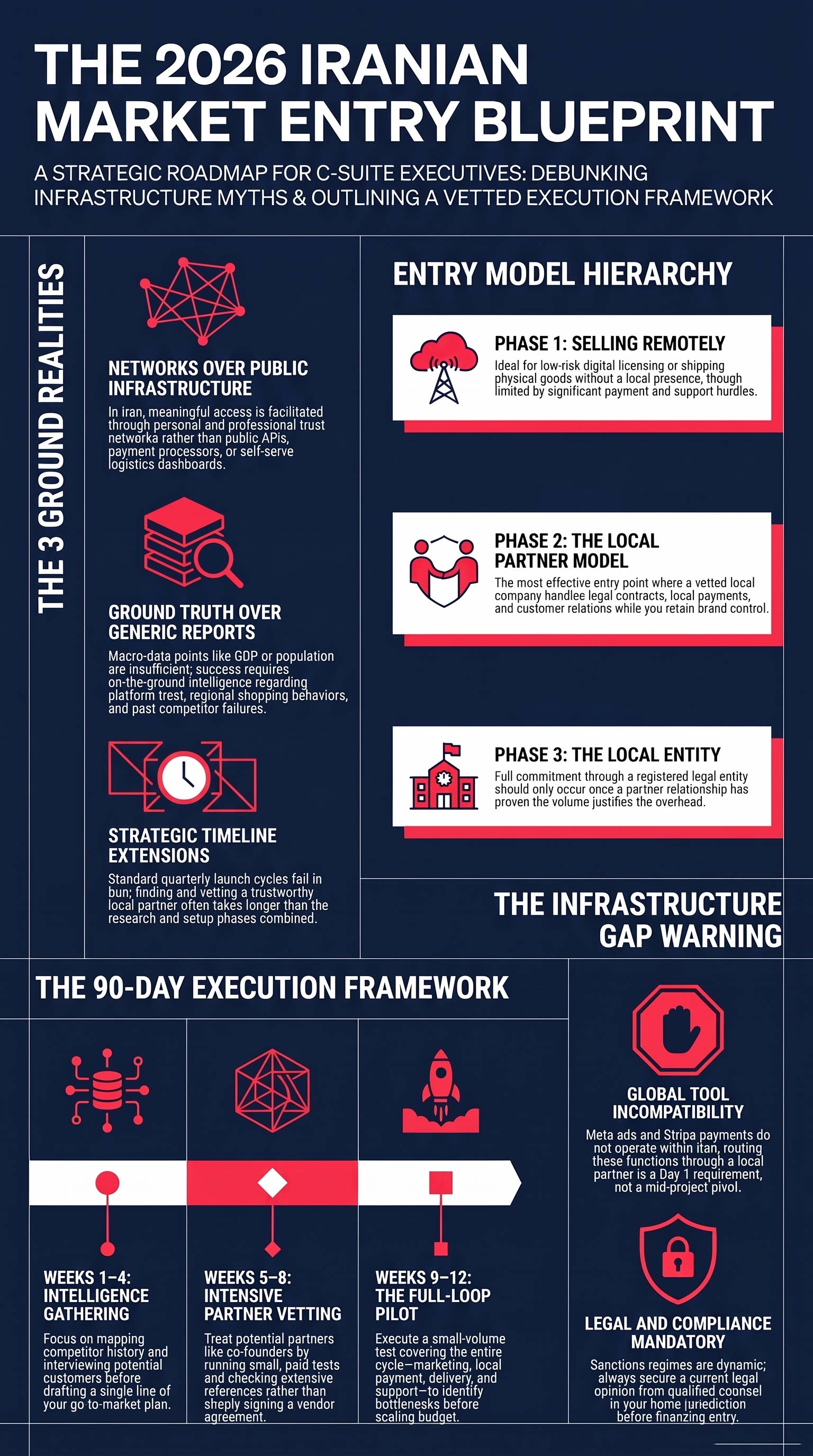
- Three realities foreign entrants underestimate: your network is your access, generic country reports aren't enough, and your timeline is probably wrong.
- Entry usually works as "partner first, entity later," never the reverse.
- Western infrastructure (payment gateways, self-serve ad panels) doesn't work here the same way and must be planned for from day one.
- A realistic 90-day framework and a partner-vetting checklist are below.
- This is not legal or financial advice.
Three realities most foreign entrants underestimate
1. Your network is your access
In most markets, a foreign company can enter through public infrastructure: a payment processor, an ad platform's self-serve dashboard, a logistics API. In Iran, a meaningful part of that infrastructure runs through personal and professional trust networks instead of public rails. Who processes your payments, who signs your contracts, who actually gets your product in front of a real buyer — all of it tends to run through someone, not a system. Arriving without that someone already in place is the single biggest predictor of a slow, expensive first year.
2. Generic market reports won't save you
Country-level reports built for a general audience are usually built from the same handful of macro data points — GDP, population, internet penetration — recycled across a dozen "emerging markets" guides. They rarely capture which platforms Iranian consumers actually trust for a specific category, how a specific age group in Tehran shops compared to a smaller city, or which of your competitors already tried and quietly failed here. That kind of intelligence has to be gathered on the ground, not extracted from a PDF.
3. Your timeline is probably wrong
Most foreign companies plan their Iran entry the way they'd plan entry into any market with reliable banking, ad infrastructure, and public data: a quarter of research, a quarter of setup, then launch. Here, finding and vetting a trustworthy local partner alone can take longer than that. Companies that treat their first six months as a search-and-verification phase, not a launch phase, are the ones still operating a year later.
What "entering the market" actually looks like
There isn't one correct model — the right one depends on your product and your risk tolerance:
- Selling remotely — shipping physical goods or licensing software into Iran without a local presence. Workable for some digital products, extremely difficult for anything requiring local payment, support, or logistics.
- A local distribution or reseller partner — the most common entry point. A vetted local company handles contracts, payment, and customer relationships on your behalf while you retain product and brand control.
- A local entity — full commitment, appropriate once a partner relationship has proven the model works and volume justifies the overhead.
Almost every successful entry I've seen follows this order: partner first, entity later — never the reverse.
The most common mistake: assuming Western infrastructure works here
International card networks and most global payment processors don't operate in Iran, and most Western ad platforms' self-serve tooling assumes a level of API access and payment integration that simply isn't available the same way. Companies that build their go-to-market plan around "we'll just run Meta ads and take Stripe payments" discover the gap only after they've already spent the budget. The fix isn't complicated — it's routing these functions through a local partner — but it has to be planned for from day one, not discovered in month three. To understand the local platforms, read Iran's E-Commerce Landscape Explained, and for customer behavior, Why Instagram Dominates Iran's Social Media.
A realistic first-90-days framework
- Weeks 1–4 — Intelligence, not outreach. Talk to real potential customers and partners before writing a single line of your go-to-market plan. Map who else in your category has already tried entering Iran, and what happened to them.
- Weeks 5–8 — Partner vetting, not partner picking. Treat this like hiring a co-founder, not signing a vendor. Check references. Run a small paid test before any exclusive agreement.
- Weeks 9–12 — A pilot, not a launch. Test the full loop — marketing, payment, delivery, support — at small volume before committing real budget to acquisition.
A Local-Partner Vetting Checklist
Before signing any exclusive agreement, ask these questions and document the answers:
- Which brands or companies have they worked with so far, and can you speak with them?
- What's their real experience in my product category, not just "trade" in general?
- How do they handle payment, settlement and delivery, and who is responsible for each?
- How do they treat end customers and after-sales support? (Ask for real examples.)
- Are they willing to start with a small, non-exclusive pilot?
Warning signs: promises that are too fast and risk-free, pressure to sign an exclusive deal before any test, and inability to introduce past customers or colleagues.
A note on legal and compliance
Everything above is market and cultural intelligence, not legal or financial advice. Sanctions regimes vary significantly by your company's home jurisdiction and change over time. Before making any entry decision, get a current legal opinion from counsel qualified in your specific jurisdiction — this is not a step to shortcut or delegate to a market consultant.
Where to start
If you want a concrete read on where you personally stand before spending real budget, take the free Iran Market-Entry Readiness Score — it takes two minutes and gives you a personalized gap analysis instead of a generic checklist. If you'd rather talk it through directly, our services page has details on how we work with foreign teams entering this market.
Frequently Asked Questions
How can a foreign company enter the Iranian market?
Usually through a vetted local distribution partner, and, once the model is proven, perhaps a local entity. Selling remotely works only for some digital products. Legal and sanctions details must be reviewed with qualified counsel.
How long does it take to see results from entering Iran?
Longer than in typical markets. Finding and vetting a local partner alone can take months; treat the first six months as a search-and-verification phase, not a launch.
Can we enter with Western marketing tools (Meta, Stripe, etc.)?
Not in the same way. Global payment gateways don't operate in Iran, and Western ad tools make assumptions that don't hold there. These must be planned from day one through a local partner and properly vetted structures.
What's the biggest mistake foreign companies make?
Assuming the infrastructure and methods of other markets work here too, and planning timelines based on markets with reliable banking and public data.