
If you're researching Iran's e-commerce landscape by mentally substituting "the local Amazon" and "the local Shopify," you're going to build the wrong plan. Iran's online retail market grew almost entirely in isolation from the global platforms most foreign teams take for granted, and it produced its own set of dominant players with their own rules. Here's the map, from someone who has worked with brands operating on all of them.
In short:
- Iranian e-commerce has no "local Amazon and Shopify"; it has its own players and its own rules.
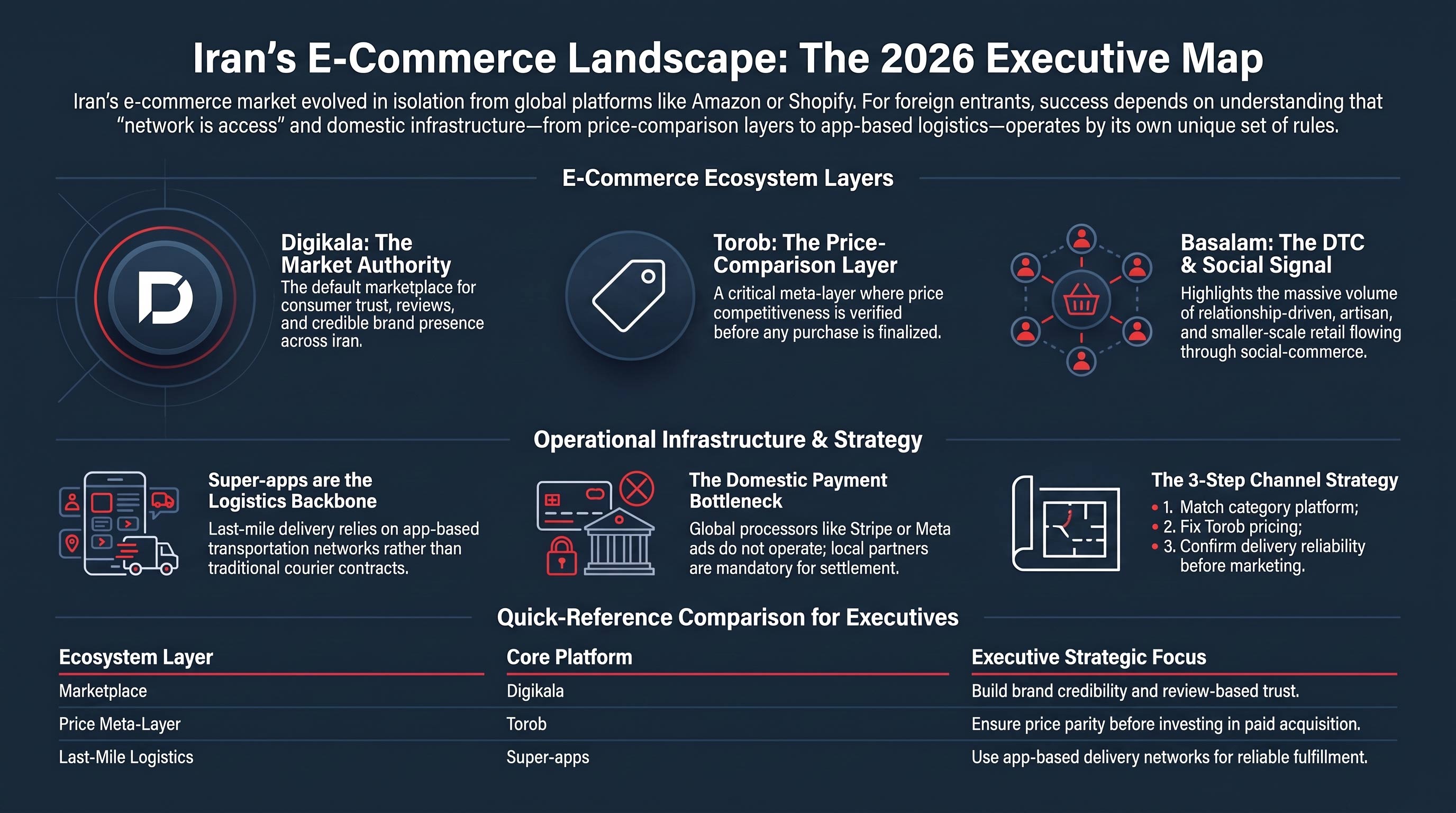
- Digikala is the main reference for comparison and trust, Basalam is the small-seller and artisan layer, Torob is the price-comparison layer, and the super-apps are the delivery layer.
- None of them solve payment for a foreign brand; that's an operational and banking matter to review with qualified counsel.
- Before choosing a platform: settle your product category, your price on Torob, and your delivery partner.
The general marketplace: Digikala
Digikala is the closest thing Iran has to a default online marketplace — the platform most Iranian consumers open first when they're comparing prices or reading reviews before a purchase, across almost every product category from electronics to groceries. For a foreign brand, appearing credibly on Digikala (through a local partner, since foreign entities can't simply open a seller account the way they might on Amazon) is closer to being listed on a national price-comparison authority than joining just another marketplace. Reviews and ratings here carry unusual weight in the buying decision.
The social-commerce and artisan layer: Basalam
Basalam occupies a different niche — smaller sellers, artisan and handmade goods, and a shopping experience closer to a curated marketplace than a mass retailer. It matters for foreign brands mainly as a signal: a meaningful share of Iranian retail volume flows through smaller, relationship-driven sellers rather than big-box retail, a pattern that shows up again and again across this market.
Price comparison as its own category: Torob
Torob functions like a price-comparison layer sitting on top of the entire e-commerce ecosystem — shoppers use it to check whether a price they saw elsewhere is competitive before buying. If your local partner's price for your product isn't competitive on Torob, you will hear about it from customers before you hear about it from your own sales data.
The delivery and logistics layer: super-apps
Ride-hailing and delivery super-apps have expanded well beyond transportation into last-mile delivery for retail and food, and for many categories they're now a more realistic delivery infrastructure than a traditional courier contract. Any go-to-market plan that treats "logistics" as a single line item, rather than a specific decision about which app-based delivery network fits your product, is missing a real piece of the puzzle.
What none of these platforms solve for you: payment
This is the part foreign teams consistently underestimate. International card networks and most global payment processors don't operate inside Iran, which means none of the platforms above give you the plug-and-play checkout experience you'd expect from an equivalent Western marketplace. In practice, this is one of the main reasons a local partner isn't optional — someone on the ground needs to handle domestic payment processing and settlement on your behalf. This is an operational and banking question, not a marketing one, and it deserves its own conversation with qualified local counsel before you commit to a channel strategy.
Which Platform for Which Job? A Quick Guide
- I want national credibility and visibility in price comparison: Digikala (through a local partner).
- My product is handmade, artisanal or distinctive, and fits small sellers: Basalam.
- I want to know if my price is competitive: Torob (before any paid acquisition).
- I need fast urban delivery (food, urgent goods, local retail): the super-apps and delivery networks.
- Direct chat with customers and relationship-driven selling: Instagram (see Why Instagram Dominates Iran's Social Media).
What this means for your channel strategy
Trying to run all of these simultaneously on day one is how foreign entrants burn budget without learning anything. A tighter approach:
- Pick the one platform that matches your specific product category, not the one with the biggest brand name.
- Get your pricing right on Torob before spending on any paid acquisition — an uncompetitive price will undermine every other channel at once.
- Decide on your delivery partner before you decide on your marketing message; delivery reliability shapes trust here more than most marketing copy does.
A Pre-Channel Checklist
- On which platform does my product category get the most search and trust?
- Who is my local partner, and how have they been vetted?
- What's my payment and settlement plan, and what has legal/financial counsel said?
- How far is my final price from competitors on Torob?
- Who guarantees delivery and after-sales support, and on what timeline?
Where to start
Platform choice is only one piece of a much larger readiness picture — local partner, payment plan, and realistic timeline usually matter more than which marketplace you launch on first. For the full picture of entering, read How to Enter the Iranian Digital Market. If you want a personalized read on where the real gaps are for your specific business, take the free Iran Market-Entry Readiness Score, or see how we work with foreign teams entering this market.
Frequently Asked Questions
Which platform should we start with in Iranian e-commerce?
It depends on your product category. Digikala for credibility and general categories, Basalam for small sellers and distinctive products, and before anything, check your price on Torob.
Can a foreign company sell directly on Digikala?
Typically not; presence is arranged through a local partner. Exact conditions can change and should be checked currently.
What role does Torob play in Iranian e-commerce?
It's a price-comparison layer over the whole ecosystem. If your price isn't competitive there, it hurts every other channel too.
How is payment handled in Iran for a foreign brand?
International card networks and most global processors don't operate there; it's usually handled through a local partner and legally/financially vetted structures. This article is not legal or financial advice and should be reviewed with qualified counsel in your jurisdiction.